A gentle reminder ...

The goal of this blog initially was for Mr. Mc to show his students and friends what he doing while in Pennsylvania and DC in 2011. Now it's being used as a place for him, travelling colleagues and former students to discuss edumacation and history related "stuff" as well as ... well, anything which pops into his head. Mr. Mc would never knowingly embarrass either the school he loves or the family he is devoted to. By joining in the discussion, he expects the same of you.

Wednesday, March 18, 2015

Open Sourced Commemoration: Remembering Lincoln and Ford's Theater

My apologies for the formatting--I am getting close to scrapping Blogger. I can't insert photo, videos and what I see in the template is not what ends up showing on the screen. Grrrr. Sorry.
Fragment of towel stained with blood of Abraham Lincoln
Towel Fragment with Lincoln's Blood
(Source: MA Historical Society through Remembering Lincoln Project)


Say what you will about 'death by committee', one of the exciting parts of working on a team is when the project or idea is presented, adopted, and then rolled out to be used. I have had the opportunity to work on the Remembering Lincoln project with about ten other teachers from across the county and Ford's Theater.

The process has been impressive to watch. The goal of Remembering Lincoln is to connect as many documents and artifacts tied to the Lincoln Assassination as possible. Rather than collecting them all at Ford's for their patrons to see, they've made patrons of everyone on the World Wide Web. By making it as open sourced as possible, we are able to see into museum and private collections from across the country and the world.
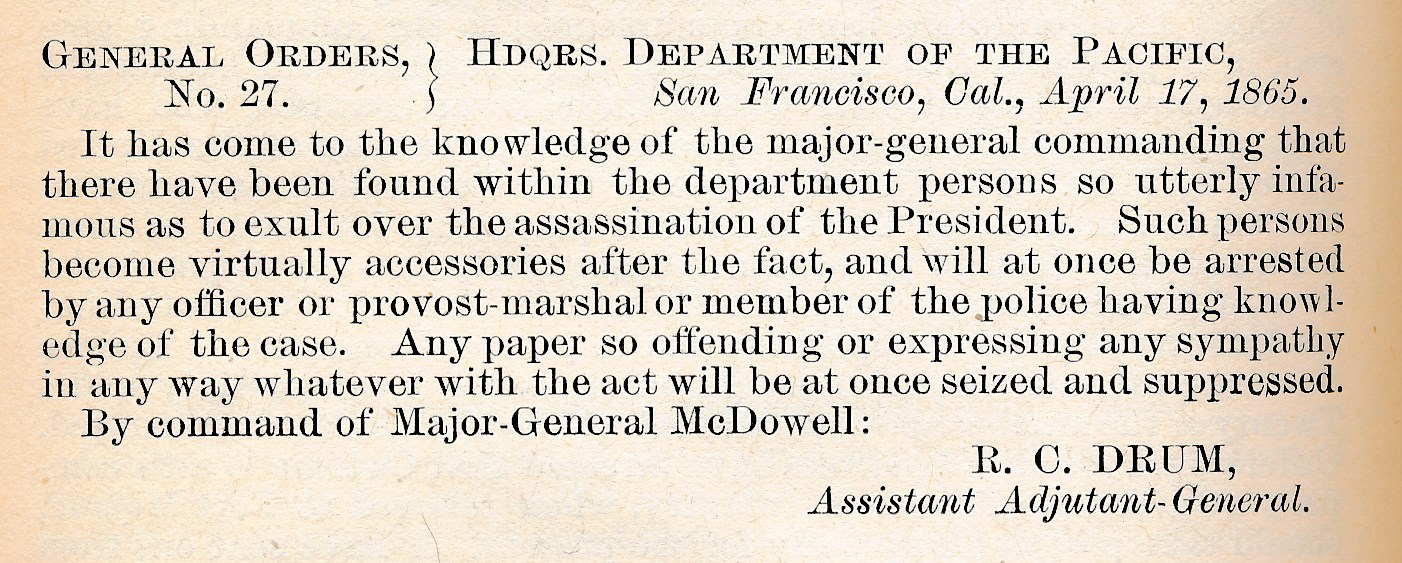

General Order No. 27 April 17, 1865
General Orders No. 27-banning the public celebration of Lincoln's murder (Source: Private collection through Remembering Lincoln Project) 


My experience of the last decade has been that museums and historical societies and research universities don't always play nice in each other's sandbox. There are just so many dollars, resources and media to go around. What has impressed me is how they've managed to accomplish Remembering Lincoln while at the same time keeping their own institutional identities. As a small cog in the process, I've gotten to see some of what went on behind the curtain to achieve this. As a result, you will find Remembering Lincoln impressively sourced. The research teacher in me says, YES! Wherever they can, Ford's had credited the sponsoring organization. That means students don't have to waste time clicking on hyperlink after hyperlink to find who actually owns each artifact, photograph,  and document.
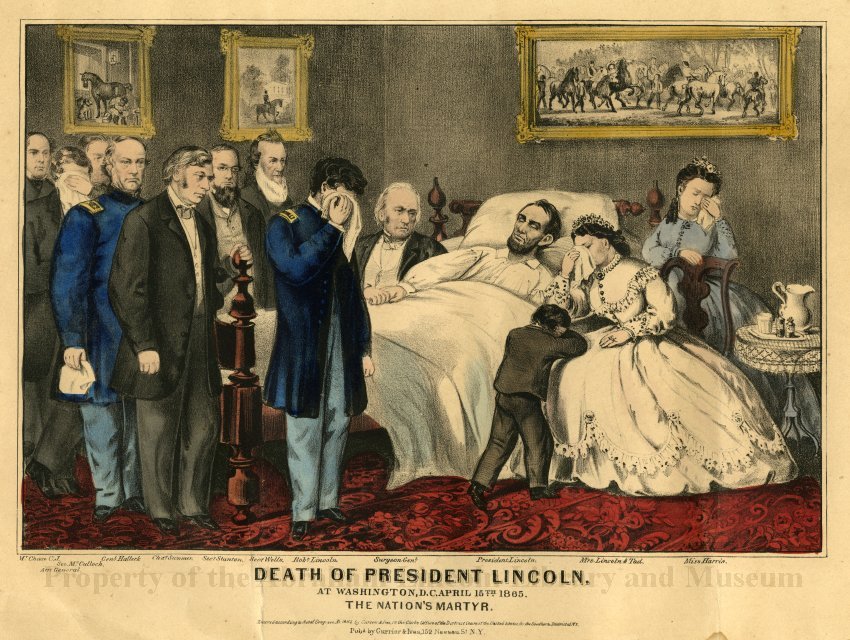

Death of President Lincoln
Lithograph-"Death of President Lincoln" (Source: Lincoln Memorial University though Remembering Lincoln Project)


As an educator, they asked me to provide a lesson plan or two for the site. The site was designed for the casual and the curious all the way to the historian or history teacher. I have two lessons I've contributed. One is a close read of the book Chasing Lincoln's Killer by James Swanson. I wanted my kids to research the event but needed something to give them a baseline on the assassination. The book does that. We are in the middle of this lesson in my class and so I am tweeking the lesson as I go. The other lesson is a little more ambitious. Once they have this baseline, I am going to deputize them a Crime Scene Investigators. Each will be assigned a person, a place or object to research. They will prepare a White Paper on their findings and present to the class. On one of my walls will be a map and place to place documents and artifacts they've found as well as a place for questions and theories on who the assassin(s) is (are). At the same time, we will follow Booth's 12 day escape route and its manhunt as well as the Abraham Lincoln's funeral train in real-time (150 years later). One moves the assassin closer to his death at Garret's Farm and the other to the president's resting place in Springfield. One will get a tomb and a nightly commemoration of his place in history. The other a site on federal land prohibiting commemoration of any kind.


BTW-Yes, I am aware that Booth is buried in a family plot in Maryland.

Sunday, March 8, 2015

Why I put my kids in private school...

Source: Louisiana Historical Society

A friend tweeted about this article in Salon. As a parent who did the opposite, I have a different perspective.


Last year, we moved our two sons to private school; one as a freshman and the other as a junior. In addition, I have three older kids who graduated from two different public schools. Even as a private school teacher, my feeling was that, as long as the public school served my kids well, that is where they could stay. They had excellent elementary experiences and positive middle school careers. Some of my private school parents asked why my kids weren't with me and sometimes it got awkward. But my wife and I had a sense of peace about the decision. Until about two years ago.


We took them out of public school because my students were getting lost. The writer of the Salon article talked about her son getting "lost in the system." She viewed it as something of an aha moment. So did I, but for different reasons.


Let me back up a bit. As a parent, I have one job: to help my children navigate the minefield that is growing up. To help them become adults who can function on their own and contribute in a way that is unique to their skills and callings. Public school was making it harder for me to do my job.


My sons were getting lost and it was taking longer and longer for teachers and administrators to notice and respond. A counselor made an academic assessment about my son after one five minute conversation and one 'drive by' conversation in the hallway. That was all he could spare in his schedule. He was supposed to be my son's advocate at the school and I don't think he could pick the boy out of a line-up. There were several exceptional teachers at this school. However, there were also teachers who locked their door after school, rather than help students. The Salon writer suggests that that environment forced her child to be their own advocate. My son tried to be an advocate for himself as well, but how do you advocate to a locked door?


The Salon writer talks about her kids developing a thicker skin and being expected to be a part of their own "education equation." She said that her son is in middle school and is a rising freshman. (I am not sure of the daughter's age, but, looking at the extra-curriculars she can take, my guess is middle or upper school.) As a middle school teacher, I would respectfully offer that the transition she is writing about is the move between lower and middle/upper school, not the move from private to public. At the secondary level, we try to instill a sense of identity and ownership in our young charges. It is their education. I can be a champion, but I can't want it more than them. I would argue that the same thing would have happened at almost any college preparatory private school. One of the challenges of teaching middle school is that there is also a learning curve for parents-from being the homework police to letting your child founder a bit so the student can learn how they learn best. Again, respectfully, this is what I think the writer is encountering, not a fundamental shift in private and public school rationales.


I would also argue that some of her concerns about public and private feel more suited to a larger school versus smaller school discussion. A school with seven high schools, fifteen middle school and dozens of elementary is a different animal than a K-12 school feeding into one high school--public or private.


From the sounds of the article, her kids are doing well and that is cool. It sounds like the decision was a good one for them.


I can say the same. My sons have gained a sense of identity that I think would have been missed in public school. One of the things about being in a smaller school is that it is hard to hide. The inability to hide can have its shadow side, but it means that your teachers know you in a way that is, quite simply, impossible in a class or 30 or 40. My son was enrolled in an AP science course based on his transcript and previous math/science grades from public school. During the first quarter of the class, I would have said it was a mistake. However, his teacher saw my son as someone to encourage and invest his time in. My son learned dogged determination and that he was someone worth investing in. After two years of barely being noticed, that was a revelation.


My sons also have had a chance to explore things that they never would have tried at a large public school. The Salon writer suggests "...if they (students) want to be perceived as extraordinary in the public school system, they had better be extraordinary. The school will not create extraordinary for them."  Again, I would suggest that this isn't a private to public school assessment, but one of development from lower to upper school. Participation ribbons pretty much ends when you get to middle school. We do give a student as many opportunities to try new things as we can, but there are winners and losers at football games, scholar's bowl and spelling bees.


Please note that I am not suggesting that private schools have it all figured out. There are private schools that are exceptional, and some that are jacked up. There are public school that are equally exceptional and some that are equally jacked up.

As one of my sons maneuvers his way through the last few weeks of his senior year, I am thankful for the teachers, both public and private, he has had in his life. We have been blessed. I hope the same for the Salon writer.
 
Source: Kansas Historical Society

As my wife and I wrestled with the move from public to private, this is what was on the table for us:


Academic--the Salon writer is correct about the academic levels being very different. Our average ACT (remember, I'm a Midwesterner) is about six points higher than our public school counterparts. We tend to have a higher percentage of National Merit Scholars than public schools. Our AP scores are higher and we offer more AP courses per capita than public schools. If you have a gifted student, is it worth the money to put them in an environment like ours? You have to decide. If you have a gifted student with a learning difference, the smaller class size and more 'nurturing' (the Salon writer's words, not mine)environment may mean the difference between thriving or getting lost in the shuffle. The cliché "A rising tide lifts all boats" applies as well. I can think of countless kids who weren't stellar students who worked harder and challenged themselves more because they were in an environment where they said, "it was cool to be smart." I have no doubt that served them well as they moved from middle to upper school (and then college).


Financial--the move was (and is) a significant financial struggle. Even with tuition remission for both boys, we spend a lot of time eating Kraft Dinners and managing a budget tighter by half. The Salon writer had to have a second job and I agree that one of the tipping points between private and public school as a parent is how time should be allotted. Do I work a second job to give my child an opportunity or is that time better spent actually with that child?


Time--our commute was fifteen minutes to public school to less than five to the private school. A few years before me moved closer for that very reason. We found that we were spending more time in the car than anything else, and that wasn't working for us.


Social (Parents)--This one is tricky for me for two reasons. As a Midwesterner, private schools here are different than on the East Coast. We fit different molds. We also were founded by someone who wanted to offer a private school education at as reasonable a price as possible. As a result, we charge half of what a private school on the East Coast does. That means our parents are more PTA than Real Housewives. It is also tricky because I am an employee of the school. I like my boundaries in that regards. I will be an advocate for my kids, but its 'bring your child to work' day everyday for me. I have a solid working relationship with parents, but its a different relationship. I image that is the same whether public or private.


Social (Students)--For me, this one is tied to the academic category. Is this a place where my student would thrive? Is it too big or too small? How does my student do socially--you may determine that public or private is a wash on this issue. BTW-Please don't let movies about private schools define your worldview. We are as varied as public. There is a gifted school within a school in the area whose students who are as full of themselves as any private school I've encountered.


Thursday, February 19, 2015

An open letter on "American Exceptionalism"...

Kansas' state motto is Ad Aspera Per Aspera: To the stars through difficulties. Rep. Fisher, I don't think we can get to the stars without being honest in our discussion of our successes and our difficulties.
 
Dear Oklahoma Representative Fisher,


I am not a resident of your state (Although as a boy from Arkansas City, Kansas, I can say with surety that I could see Oklahoma 'from my house' to quote a political pundit. :)). I also am not an AP history teacher, but I would like to weigh in on your recent bill in your state's legislature.
 
As a middle school history teacher, I often use the phrase, "Say more" to get a student to dig deeper into an answer or thought. I'm not challenging or correcting the idea. I just need more information.
 
So I am asking you, what do you mean by American Exceptionalism?
 
I do agree that America is exceptional. I am so proud of so much of what we've become and what we will become. I love the preamble of the Constitution's idea of a "more perfect union." I see that as one of my callings as a teacher. How can I get my young charges to see into the future and see what's next for the American experiment? What notion do we need to wrestle with? What concept do we need to challenge? I think that is the calling of our elected officials, as well. That is why I am asking you to say more.
 
I think that we are exceptional. But we are not done.
 
I think that exceptional isn't a location or one static moment. I hate this cliché, but clichés are almost based on a truism. Exceptionalism isn't the destination but the journey itself. Our goal is to be more perfect and we can't get there without honest assessment.
 
Some of my favorite moments in my classroom have come when we have wrestled with what is difficult.
 
  • Supreme Court cases like Tinker v. Des Moines--what makes for an appropriate learning environment in the midst of turbulent social and political moments in history? (I noticed in the suggested list in the text of the bill that there were no Supreme Court decisions. I think that is problematic. I say, respectfully, that to miss the voice of one third of our governmental leadership is shortsighted.)
  • Global Warming--what is our responsibility to the world in which we live?
  • Manifest Destiny--how can we reconcile this American need to expand with the genuine wrongs we inflicted on nations of people? (De Tocqueville would suggest the policies of westward expansion crippled both Native Americans and enslaved people, and I would agree. I am pleased he made the list.)
  • Race--Lincoln suggested in his Second Inaugural (I am excited to see this speech made your list.) that 250 years of sin as a nation for the institution of slavery might need to be countered by 250 years of penance after slavery. I think he may have closer to right than I wish to admit. How do we, then, help the truly bottom-stuck, encourage those who Dr. King pointed out have rights but no hope, and foster racial cooperation and dialogue that goes beyond platitudes and hyperbole?
 
Rep. Fisher, these are questions my 14 year olds want answered. They don't want to shy away from them. They take Madison and Jefferson at their word. I am humbled by their fearlessness.


Again, I think that we are exceptional. But we are not done.


I think you and I differ on the result of what we see in the APUSH curriculum. In the hands of skilled AP teachers, student's wrestle with the ideas of the national narrative by looking at all our moments, best and worst. I can say in my ten years as an educator, I know dozens of AP teachers who do that work and do it brilliantly. I can say one of the finest teacher's I know teaches APUSH in Oklahoma. You should ask him his thoughts on the subject. I honestly don't know what his answers would be, but I tell my charges that a primary source is the motherload for any researcher. Secondary sources are helpful, but primary sources are GOLD!


In a missive already too long, may I ask a couple questions about the bill?


Is the goal to rewrite curriculum because of its content or its source? Part of the newspaper analysis of the bill suggests this is about 'nationalized' education. If it is, that is fine. However that reframes the question from American Exceptionalism to politics. If its about the politics of education, I would like to graciously bow out of the conversation. My interest is in how to be a better educator, not listening to bloviating from both sides with children caught in the cross-fire.


How many educators and students have you brought into this discussion? Not politician or PACs. Not administrators. I would even avoid parents in the initial discussions; just start with the people in the classroom. I noticed that by the end of the day HR 130 was withdrawn due to the responses you received over its vote in committee.  I say with all respect that my response to that is that this was a half-formed idea that many teachers would have challenged you to rethink well before it made its way to committee. If that is incorrect, please accept my apology. To my untrained eyes, however...


Again, Rep. Fisher, please accept this letter in the manner it is intended. Public Service is one of the things that I think makes America exceptional. We are all expected to be civic-minded. I hold the Capra-esque view that no one enters the public arena with blind ambition and ambivalence to their fellow man. And for your service to your state, I thank you.


Dave McIntire

Friday, February 13, 2015

Open Source...the sequel!

Bloggers note: Okay, I just posted this and then read a friend's post from last month. He is a brilliant educator and I aspire to be as passionate, skilled and caring as Chad. READ his post...we have some similar ideas; I took mine inward-he took his outward to talk about a broken system. Brilliant work, Chad.


This picture has no real purpose other than to show I have two books on Lincoln. That makes me an expert, right?


In my last post, I talked about making my teaching more open sourced. two thoughts--one something which surprised me and one another example.

 
Point one:
It's funny, several people emailed or messaged me on social media that they thought I was being too hard on myself. They were very encouraging; saying that the way I taught was a nice blend of sage on the stage and guide on the side. A couple are people whose opinion I really, really value. I think I didn't do a good job explaining my pondering. I wasn't bashing myself; I was just wonder if I could do better and making the classroom more of a student-directed laboratory. The answer is yes. I am proud of my work as an educator, but I am always looking for ways to be better for my young charges.


Not only have I read two books on Lincoln, I have shopped at places which sell books on Lincoln. This is The Strand in NYC..


Point two:
For Lincoln's Birthday, Ford's Theater has been live tweeting a Q and A session between anyone on social media and themselves. Different staff members take the mic (so to speak) and spend an hour or two answering the questions that come in. As my students were researching their Civil War topics, several had questions they wanted to ask. It was completely organic and completely optional and completely awesome. Some of the questions, you ask?

  1. Who would be better at basketball--President Lincoln or President Obama? (Ford's said Lincoln but several of my students respectfully disagreed.)

  2. Was the stovepipe hat to cover a bump or scar on his head? (Ford's talked about the hat being one of his signature items--maybe a political gimmick. They even shared an article on the hat and its significance.)

  3. What was Lincoln's favorite color? (The staff person suggested blue but admitted it was their favorite color so maybe that 'colored' their evidence.) BTW-this kinda silly question led to an informal discussion of how a researcher's bias might affect the outcome.

  4. What was Lincoln's biggest fear? (Historians suggest that AL had a life-long battle with depression so fear and anxiety were no stranger to Mr. Lincoln.) It sets us up for a future discussion about the teeming masses expectations of a Kevlar President and the reality that they are all too flawed.

  5. What was L's take on God? This came from an 8th grader! (The response that followed was nuansed--Lincoln seems to evolve from New Salem and his debating society to the White House. Another article was suggested.) 

My favorite question of the day was one I poo poo-ed when it was suggested:

  1. Did AL have a pet turkey named Tom? (The answer is that it wasn't a pet but a gift for Thanksgiving Dinner and that his son's pled for its life--creating the annual turkey pardoning at which Sasha and Malia Obama were unfairly spanked by some Republican's this year. BTW-There is a great article about the incident from the Washington Post here. Enjoy.)
So, while researching something else...we covered turkeys, adolescence, basketball, fashion and mental illness. Not bad for a morning and social media.


This is Flat Stanley at the Smithsonian American Art Museum. The painting is Thomas Hart Benton's Aeschylus and Hercules. We were talking about wrestling with the Civil War and Lincoln and I thought of this painting. After the first two, you gotta be excited that this one has even a scintilla of a reason to be on the page, right?


Thursday, February 12, 2015

An open sourced education


Source: The White House

Happy Lincoln's Birthday ya'll. That's not the topic of the post, but part of my thoughts have come from events surrounding Honest Abe.


I have been thinking about this idea for some time. What if we ignored all the edumacational stuff and just told kids they were in charge of their education? What if we got out of the way? What if we asked them where they wanted to go and then helped them chart a path to get there.


As people who are further on the journey, teachers have some insights they need to hear, and we can and should offer them. However, when did education become about the adults? We're done with our formal education-and the system did right by most of us. I don't think the system has done right by its most recent acolytes. We carry some of that blame.


I keep coming back to the idea of open sourcing...
Let them search for themselves, ask each other, use the tools of today to answer the questions left by the past.


I've restructured my Civil War unit as a little thought experiment. Its not a new idea so I won't even begin to take credit for it. Instead of me as the sage from the stage, I guide from the side and let them assume the mantle of the expert. (Extra credit should be given for using three hackneyed educational clichés-don't you think?)
 
  • Step one--read the chapter--don't take notes, just read and try to understand.
  • Step two--read and annotate a section of the chapter--try to become really familiar with that portion of the Civil War.
  • Step three-research one topic (Battle of Antietam, Freedman's Bureau, Stonewall Jackson...) for three days and then report your findings to the whole class.
  • Step four--take notes during your classmates presentations (in our case--using a study guide)
  • Step five--the teacher ties any loose ends that may occur. The reality is I need to assess how well they understand the Civil War and the study guide helps put it all together.

What has been encouraging has been my student's willingness to roll up their sleeves and become an expert. I'm there giving them suggestions, but they are doing the work. Their questions of clarification are solid and even when stuck they haven't given up--they've just asked for help to rock the tires out of the rut.


There has been a sense of partnership that is missing on lecture days. I am hoping that it gives them confidence to look for their own answer to those things that matter most to them. I am not a fool, not everyone is a history nerd. and that is okay.


In looking at what has helped me with open sourcing, one thing that's been central has been the acceptance that, while I am a smart guy, I am not the Lone Ranger on that account, even (or especially, for that matter) in my classroom. I shouldn't be the only 'expert of things historical' in the room. That is just silly. I have the privilege of teaching curious young women and men and they blow me away with their insights and questions. A valuable tool in the open sourcing of my classroom has been technology and social media--information and experts are at your fingertips.
 
A case in point:


The bed in question

One of my kids asked this morning at about 9:30 am CST about Lincoln being shot in a theater but dying in a boarding house. That got us on a rabbit trail about what happened to the room where Lincoln died. I started to tell them a story about the boarder in that room, but couldn't remember his name. One Facebook post and three minutes later and we had it--the bed on which Lincoln died was in the room rented by William T. Clark. I told them that Clark would end up sleeping in that bed and they asked if he changed the linens. One more Facebook post and about ten minutes later and we had our answer--yes, he did. The teacher-scholar with this information also shared information about Lincoln's boots and their connection to Mr. Clark. By 11:20 a.m. CST, we had the full story of Mr. Lincoln, Mr. Clark, Lincoln's boots and the Peterson House. Kids came by during passing periods to ask if I had more information. When was the last time a kid wanted more information after leaving class?


Its the part of teaching that makes it all worthwhile. Messy and loud and with bursts and starts...but worthwhile.


Tuesday, January 13, 2015

Podium Point Eight: The eyes have it...


Creepy, huh?!
The eighth podium point is eye contact.

Eye contact is all about balance. Too little and you seem disconnected from your audience. Too much and, well, its just skeeves everyone out.

As young speakers, my charges are slaves to their documents when they speak. It makes complete sense. They are learning how to stand, how to speak, how to sound while they speak, ... at the same time they are processing words into language. That's a lot to take in and manage.

One of the suggestions we make for them that I have taken up is writing in my speech or remarks moments where I want to intentionally look up. If I know I am going to look up there, I tend to memorize the words before and after so it looks seamless.

The value of eye contact is, well, invaluable. It shows confidence. It shows a connection to the audience. It shows that you are prepared.

The power of our eyes can't be denied. Just look at this article from Forbes magazine. Even the gaze of rabbit on a cereal box is powerful.

One of my favorite characters on television right now is Suzanne "Crazy Eyes" Warren from Orange is the New Black. Uza Aduba, the actress who plays her completely gets how powerful one set of eyes can be. She uses her to craft a complex and fascinating character. (For the record: I would never, ever, suggest kids my student's age watch Orange is the New Black. Never. Ever. Ever.)

The Wall Street Journal reported that about a study that found that eye contact in casual conversations is on the decline as the result of SMART phones. It also has some solid metrics about how often one should look someone in the eye and for how long, as well as cultural considerations.


Source: New Yorker Magazine

Tuesday, January 6, 2015

Podium Point Seven: Don't get all bent out of shape!


How many of us had a mother who cajoled us to, "Stand Up Straight!"? As a speaker, listen to your mother.


It sounds deceptively simple. And it is. However, when you look at the act of speaking, posture is central to success. Standing erect helps with presence, pace, diction and volume.


So much of what we do nowadays works against a student's posture. Looking at SMARTphones, computer desks and terminals, and backpacks, its a wonder our kids can walk upright.


With all the FitBit devices out there, it is no surprise that one of them, by Arki, analyzes posture as you walk. I hadn't thought about it, but it makes sense that posture affects how productive your steps are. There is a device you strap to your back and run via Bluetooth, but I like that the Arki device analyzes gait and suggests fixes there. (BTW-sorry about not being able to imbed the video from Arki. For some reason, videos won't upload on Blogger...working on getting that resolved.)

So, listen your mother. And it would hurt to call now and then, would it?


Monday, January 5, 2015

The private school teacher post--the reboot

It has been an interesting few days for me with the blog. The previous blog entry, has made it into my 'most read' top ten within a couple days. That has been out of more than 250 posts over three years of posting--cool.


I have had several people talk to me or email me about the post, which is also unprecedented. Most of the folks who have messaged me had pretty much the same comment, "What was it that you wished you could say that you thought was going to peeve people?" or "It felt like you stopped half way through your thought." or "What was your point?"


I went back and read it...these are fair points.


My admission is that I pulled my punches in that post. I decided this thread would take a few posts to get my thoughts out there and so decided to close that post with some baseline about private schools not being one 'thing'. Mission Accomplished. Add to that that I am an 'ice cream truck' (I want everyone to be happy) so there might have a bit of yellow streak shown, as well.


So here it goes. Here are three thoughts, not necessarily in any order. BTW-these may not be issues where you would think there would be a lot of 'pushback'. Think of these as the opening remarks of a 'yellow-bellied ice cream truck'. I'll save provocative to later.


My students are somehow 'easier to teach' than theirs--this one makes me a little crazy for a couple reasons. My student's come from such a wide range of experiences and academic abilities and learning styles and ... (You get my point, right?) They are by no means homogenous. It is true I don't have significant numbers of my kids living in poverty or in a warzone, but neither do most teachers. (One of the teachers who inspires me teaches in inner city Philly. What she does with these young women and men makes my challenges a cakewalk. The funny thing is, I have never, ever heard her compare her students to other students. That is a lesson I have tried to take to heart.) That leads me to the other reason it makes me crazy: if feels as if the teachers who say this see their students as 'less than'. That breaks my heart.


BTW-there is a strain of this that goes that my students are snooty, privileged rich kids whose tutor does their homework for them so they can fly to ... Grrrrrrrr.


My rich, elitist parents--Just because a parent sends their kids to a private school doesn't mean they are wealthy. For most of my parents, tuition is a significant sacrifice and they do without so their child can attend. I can speak as a parent of private school kids, I wouldn't be able to send them without scholarships. Do we have really wealthy parents? Yup. Do we have parents who are working two jobs to send their kids here,?  Yup. The cool part of my school is that I see parents working hard to make it about their kids and not their wealth or lack-there-of.


BTW-there is a strain on this one two that makes my parents something out of Dickens' novel. Either uninvolved and uncaring or Queen of the Tiger Moms. My parents pay cash money (above and beyond property tax) to have me educate their kids. Are they interested?  Yup. Do we always agree on best practices? No. The challenge is always how to manage that conflict in the best interest of the child.


Private school teachers are not 'real' teachers--I travel a lot during the summer with teachers and, invariably, we end up talking shop. I have found that, sometimes, my thoughts and experiences and successes are somehow 'suspect' because of where I teach. Unless you teach in an inner city or an Indian reservation or with a population with special needs, I would argue that the classroom is the classroom. I don't have little Stepford students filing into their seats. My students are kids, with all the baggage that comes from being a kid in the 21st Century. I am challenged with-just like my peers all across the country-with making sure that what I do in the classroom is both meaningful and engaging. Period.


As I said before, these are three thoughts. I have more.


As I said in the previous posts, I am not opposed to a discussion of the view of private schools. I would covet your thoughts in the comments section below. If you are a Facebook friend, don't post on Facebook, post here, okay? And leave your name, okay?


Wednesday, December 31, 2014

What a private school teacher wishes he could say...

There was a Washington Post blog entry last May that someone suggested on Facebook: What If Finland's Great Teachers Taught in U.S. Schools? It was written by a leader in education in Finland, Pasi Sahlburg. I read a very interesting book last summer about Finnish (and other top performing) schools titled, The Smartest Kids in the World, so the question caught my eye. The article (and the book) are an interesting read.


One of the last paragraphs of the blog entry is pretty provocative...


To finish up, let’s do one theoretical experiment. We transport highly trained Finnish teachers to work in, say, Indiana in the United States (and Indiana teachers would go to Finland). After five years—assuming that the Finnish teachers showed up fluent in English and that education policies in Indiana would continue as planned—we would check whether these teachers have been able to improve test scores in state-mandated student assessments.
He finished the thought experiment saying that the Finnish teacher in Indiana would  be less effective and the American teacher in Finland would be more effective. Why? He posits that the American teacher in Finland would:

stand to flourish on account of the freedom to teach without the constraints of standardized curricula and the pressure of standardized testing; strong leadership from principals who know the classroom from years of experience as teachers; a professional culture of collaboration; and support from homes unchallenged by poverty.


Now we can spend time unpacking those ideas--the socioeconomic status of our kids and their success; administrators and the lens of classroom experience; and a 'culture of collaboration' in the teacher's lounges.


I'm not done with my own unpacking, but I will say I do agree with him on some cursory level. The school I teach at is considered successful. We regularly have a high percentage of National Merit awards each year. Our students receive millions of dollars in scholarships based on their academic prowess, athletic ability as well as leadership experience and potential. As importantly, we have college students who regularly come back to us and say they were prepared for the rigors of university.


We are successful, in large part because we meet the Finnish design. Teachers passionate about students and their subjects. My boss was a classroom teacher for 20+ years before joining the administration. Our school was founded on the concept that teachers are expected to be leaders and entrepreneurs in their classroom and should be given the respect and latitude that a leader/entrepreneur needs. We are expected to develop curriculum rather than receive it top-down from administrators. We have a wide range of families (wealthy to middle class; natural-born and naturalized; multi-faith...) on our campus, but there is a general understanding that there is a common goal--the student. We don't always agree how to achieve that goal, but the goal is to keep the student in the center of any conversation/collaboration. We are most definitely not perfect. We have challenges we need to deal with. We certainly don't have a ...


...This is where my friends remind me that I teach at a private school and that public school's have it much harder which makes it more difficult to fix.


And I agree. Sort of.


Normally, I would sit quietly, nurse my beer, and listen to the laundry list of reasons why public schools can't (fill in the blank)...


But, I am feeling a little froggy today and have decided that 2015 is the year of Mr. Mc--private school teacher. I know my thoughts on the subject are going to peeve a few people and I respect that. I am more than happy for this blog to be a spot for passionate dialogue on the issue of education. Actually, I would be delighted for it to be a place for passionate discussion. I told someone last night that I was thinking about shuttering the blog because it didn't seem worth writing anymore. This thread (why private schools are vital to  American education) may fall flat, but, well, there is learning in failure, isn't there. Besides, I'd rather shutter the blog knowing I tried to have a conversation.


So, today's thought is that many of the people who talk about private school education have no flippin' idea of the subject. To them I would (politely) ask: please shut your pie hole.


I have been teaching in a private school for ten years and, in as many years, I've listened to people (teachers, administrators, parents, ...) make statements about private schools which are stereotypically overbroad, dismissive to the point of being mean-spirited and just plain ignorant or stupid. (BTW-ignorant is when you speak with out the facts/stupid is when the facts are available, you just ignore them.)


If you do some research, you will find that there are several types of private school. Some are the toney East Coast Boarding school's most people think of when they hear private school--think Phillips Exeter School in New Hampshire. Some are school's of last resort for students with learning differences--think of The Greenwood School, featured in Ken Burn's The Address. Some are focused on specific fields like Interlochen Arts Academy in Michigan. Some are focused on training up students in a particular faith/denomination--think parochial schools. Most private schools fit somewhere in the middle of all of these.


If you think of Dead Poet's Society when you think of private schools, you are off by about six decades as well as a mile.

Wednesday, December 24, 2014

Trivia Crack and the History Teacher


I withheld as long as I could.


After several weeks of hearing about Trivia Crack, I succumbed. If you don't know the app, its Trivial Pursuit meets Wheel of Fortune meets Jeopardy. It is also addictive. I am currently playing about 10 games with friends at the same time.


Shock of shocks--my best area is history. Shock of shocks (the sequel)--my worst area is sports, followed closely by science.


Here is the question I have...Is Trivia Crack a useful tool for an educator. Its popular and fun to play, but does it (or any trivia game) show learning has taken place? In some ways, a comprehensive test (multiple choice, true and false, blah blah blah) is a kissing cousin to Trivia Crack isn't it? How well can you regurgitate data?


I prefer assessments which require more than just data regurgitation. Writing a paper. Analyzing a map, photograph or piece of art. Creating a podcast or documentary. Show me you know the data by showing me how you'd use the data.


Now, data regurgitation has a place in the classroom. The 'teachery' jargon is formative versus summative assessments. Formative assessments are those checks while you are in learning mode. Data regurgitation can be a useful formative tool. Summative is an assessment at the end--what did you learn and how can you use that information in a meaningful way? My feeling is that a summative assessment needs to go beyond data regurgitation.


I remember reading a story about a class that had an all-day project. A farmer unloaded a huge pumpkin to the school's doorstep. It was far too large to get the pumpkin in through the doors. So the student's worked all day to figure it our. They had to use math to figure out slope and calculate measurements. They had to communicate with each other by writing out questions and the corresponding answers in a way others could understand, interpret and respond to. They employed scientific method. They had to learn from mistakes without letting the mistakes consume them. In the end they had to report their findings, whether they were successful or not. As a teacher, its hard to manage chaos and not feel the need to jump in and 'help.' Its difficult as a parent as well. However, I love the idea that we hand the kids the keys and say, we trust you enough to get out of the way. To me, that is where you get a real assessment of the work you've done.


As I've been writing, I realized that this is a new thought for me. I've written about this idea before. Here is that link.

As I've said before, this is a place for me to dump ideas. So I can remember them again in the coming months. Consider these thoughts on assessment dumped...besides, my computer just let me know its my turn, pray I don't get sports or science this time.

BTW-happy holidays for the folks who read this blog.


Friday, December 12, 2014

Back to Before...


This blog was originally designed to record my experiences one summer at a professional development course (two actually). The Presidential Academy selected one teacher from each state and then brought us to Philly, Gettysburg and DC for one week each to discuss the Declaration of Independence, the Gettysburg Address and the Civil Rights Movement. That was the inspiration of the blog's name--Declaration Address and Dream.


Today I had a little bit of a deja vu from 2011. Dr. Lucas Morel of Washington and Lee University presented for the Gilder Lehrman Institute. Dr. Morel was the lead professor for the Presidential Academy and when I saw his name on the literature, I knew I was signing up.


For the interested, a review of some of the posts from Summer 2011:


Big Arnold and Your Bike


Pictures from the Walking Tour


Gettysburg and History as Art


Photos From the Battlefield


Gettysburg National Cemetery


Talk May Be Cheap, But it is Necessary


John Brown, Domestic Terrorist


I Want to Like Woodrow Wilson, I Really, Really Do


Some Pictures From DC


A Day in the Senate


A Morning in the House


70 Hours in the Classroom, 9 Sites, Battlefields and Tours, 3300 Pages of Reading


In one of my posts that summer, I explained what I liked about Dr. Morel's teaching style:
What I like about sitting in one of Dr. Morel's lectures is that there is an expected give and take. He asks questions looking not necessarily for the right 'answer' but an answer that gets us on the field and moving toward that answer. To participate, you have to know the material, not in a regurgitated ATM sort of way but an organic way of moving toward a concept or big idea. Its a teaching style which encourages participation and requires preparation. You want to get in the game. It is a pleasure to listen to what the other participants have to say about the Lyceum Speech or in response to the handbill pronouncing Lincoln an atheist.
It is a style I both enjoy and try to emulate. I can say that on several of the few moments I consider my most successful as an educator-this is the style I have employed.


I didn't get a chance to say thank you to Dr. Morel today, so let this post be that--Thank you Dr. Morel.


Sunday, December 7, 2014

My kingdom for a speech, a slam poem and a sonnet...


After two weeks of wresting, my students have selected their historic speeches. They will research them this quarter and them work on them as orators in the next. On the way to their selection, something interesting happened. My rule was that no speech could be repeated each hour, which left the possibility that some of the speeches would be delivered three times; one for each hour. This year, no student is preparing the same speech.

None. Nada. Zip.

One of the things I've learned through the Ford's process is how long real professional development can take. During the first year of the program, I was just holding on for dear life. I am proud of the work we did that year, but most of its success was the Teaching Artist, Jojo. Last year was more of a partnership with our new Teaching Artist, Victoria. I took more leadership and we added sonnets. This year, this semester, I have taken more of the helm and Victoria is more a champion for me as a teacher of oratory than a teacher of oratory of herself. Her real work will be in the second semester as we partner together as coaches for our young charges. After two years of doing this, one thing which I thought I needed to change was how much time students had picking speeches, as well as trying to match the DNA of the speaker to the DNA of the speech. I have to admit to being a little surprised to how smoothly that went. These speeches ar both good fits for the individual kid as well as ones they are genuinely excited to work on.

Another surprise has been my exploration of slam poetry. I'm fifty and an old dog in so many ways, but spoken word performance has me smitten. The clips above and below are some of what I've found. I am looking forward to pairing spoken word with sonnets next semester. Could be either a big hot mess or brilliant.

Either way, we'll learn something. That's the point, isn't it?


BTW-I have been triple double dog dared to write my Ford's speech as a spoken word poem. I'm not sure if I can do it, but I keep you posted.

What speeches did my charges select, you ask? If you have a chance, google a few of the ones you don't recognize. I am so excited to see where my kids take these.


RFK, “On the Assassination of MLK, Jr.”
Daniel Webster, “Bunker Hill Oration”
Emma Watson, “Gender Equality is Your Issue, Too”
Michael  Jordon, “Hall of Fame Enshrinement” Speech
Hillary Clinton, “Women’s Rights are Human Rights”
FDR, “A Date Which Will Live in Infamy”
Patrick Henry, “Give Me Liberty or Give Me Death”
Michelle Kwan, “Worldly Wisdom to Grads” Speech
 
Malala  Yousafzai, “Address to the UN”
 
Lou Gehrig, ”Luckiest Man on the Face of the Earth”
 
Neil Gaiman, “Commencement Speech to University of the Arts Philadelphia”
 
Savannah Brown, “What a Guy Looks for in Girls—A Response”
 
JFK, “Ask What you Can Do For Your Country”
 
Hellen Keller, “Strike Against War”
 
Ronald Reagan, “First Inaugural”
 
Ronald Reagan, “Mr. Gorbachev, Tear Down This Wall”
 
Cal Ripken Jr., “Farewell to Baseball”
 
Lily Myers, “If I Should Have a Daughter”
 
MLK, Jr., “There Comes a Time When People Get Tired”
 
Severn Suzuki, “1992 UN Earth Summit Speech”
 
Ron Paul, “Farewell to Congress” Speech
 
Charles B. Morgan Jr., “Four Little Girls Were Killed”
 
Sarah Kay, “Tshotsholoza”
 
Elizabeth Cady Stanton, “The Solitude of Self”
 
Harvey Milk, “You’ve Gotta Have Hope”
 
JFK, “Let Them Come to Berlin”
 
Lily Myer, “Shrinking Woman”
 
Aung San Suu Kyi, “Freedom From Fear”
 
Fredrick Douglass, “What to a Slave is the Fourth of July”
 
Lucy Stone, “A Disappointed Woman”
 
Sojourner Truth, “Ain’t I a Woman?”
 
Abraham Lincoln, "Second Inaugural"