A gentle reminder ...

The goal of this blog initially was for Mr. Mc to show his students and friends what he doing while in Pennsylvania and DC in 2011. Now it's being used as a place for him, travelling colleagues and former students to discuss edumacation and history related "stuff" as well as ... well, anything which pops into his head. Mr. Mc would never knowingly embarrass either the school he loves or the family he is devoted to. By joining in the discussion, he expects the same of you.

Saturday, September 10, 2011

"It looks like a gunshot through Montana!"

The first week of school is a odd time in the life of a school. The kids are still stretching from a three month nap.They are excited to see old friends and embracing the 'school' part of school is a necessary evil in order to see said friends. The teachers are in the midst of a ten yard dash to get ready for students. They are chomping at the bit to talk, discuss, instruct, show, play, and ... (let's be honest teachers, laminate!) Its a dynamic I wish I could explain to those who don't spend  a lot of time in a classroom.

This year I thought I would try one of the Smithsonian strategies out and see if it would work. We called it "Artwork of the Week" and here is what we did:

 
State Names. 2000. Jaune Quick-To-See Smith. Born: St. Ignatius, Montana 1940. oil, collage and mixed media on canvas. 48 x 72 in. (121.9 x 182.9 cm). Smithsonian American Art Museum. Gift of Elizabeth Ann Dugan and museum purchase. 2004.28.

On the first or second day of school they saw this painting projected on the SMARTboard. No discussion.
For the next couple of days after they made observations using a process called VTS (Visual Thinking Strategies). VTS is pretty easy to explain but challenging to actually do (more on that later). The facilitator can ask one of three questions:
  • What is going on in this picture?
  • What do you see that makes you say that?
  • What else can you find.
The facilitator should:
  • remain neutral, 
  • repeat the response to the observer in order to make sure they understood the comment, and 
  • point when necessary to where the observer is talking to get everyone focus on the same part of the piece.
The killer part is remaining neutral. Part of giving feedback, for me, is praise. Praise encourages, it creates a positive attitude in the class and it can help guide a class into the direction you want them to head. For VTS, the danger of getting them to go 'my way' outweighs the encouragement and positive environment praise fosters. The point is to get them to think for themselves, not for the facilitator. "What are 'they' thinking?" not "What do they think I want them to think?"


When I let them tell me what they thought about the painting, they floored me. I did this process in DC with about five teachers and an art history major as a facilitator. I think my kids blew us out of the water. They saw things and made connections I don't think we would have. Some of them would turn out to be wrong but they always returned back to the painting. Here are the responses. (Note that I haven't copied the title or artist information. It isn't shown to the observers until after they've responded lest it influence their comments.)


A sampling of comments:

Rain 

Since the states are fighting for independence, I think it has to do with the Declaration of Independence.

I think it means that the drippings represent the pain that the US has gone through but we're all still here and its built America to what we are today.

Emotional.

I think the Indians are represented by their wars, words, names and homes. Their emotions could be represented by the dripping paint.

It is a depiction of our modern economy and which states play a more positive role in how the US is connected.

Dripping.

 The white symbolizes indifference, while blue is more bias and red is extremely biased.

The painter is sad and therefore the painting is sloppy.

It looks like a gunshot through Montana.

The United States is falling apart.

Most of the names by the water are no there so maybe that has something to do with it (the ocean) being black.

The Indians were angry at the people for taking their land ... maybe.

Smudged on purpose.

I think the bleeding of the colors represent something of pain. Bleedings are the key word for me.

Do you see what I mean? The link below is for the Smithsonian American Art Museum's page for this piece.  Below the image of the painting is a place to hear more about the painting. Click on it to hear what the artist herself has said about the piece and why she creates the art she does.Quite honestly, I like some of my kid's interpretations as well as the artist's comments.


The bottom line in the classroom is that in about the equivalent of 30-40 minutes, my students were schooled in Indian displacement in a way that causes them to continue to talk about the issue. We just finished talking about Jamestown and Plimoth and they asked about the indigenous tribes right off the bat. It was awesome. When we get to Manifest Destiny, State Names will play a large part as we wrestle with the shadow side of the Northwest Ordinance, Cherokee Nation v. Georgia and the Homestead Act.


Finish up at the Smithosonian ...

Sorry for the long delay in posts. The start of school at work and home, ...'nough said.

The last couple of days at the Smithsonian we spent working on our presentations. They showed us how to record on Audacity and then on VoiceThread. Our assignment was to record a podcast based on the artwork we had selected. Here is the painting I selected oh so many months ago ...

 
Achelous and Hercules.1947. Thomas Hart Benton. Born: Neosho, Missouri 1889. Died: Kansas City, Missouri 1975. tempera and oil on canvas mounted on plywood. 62 7/8 x 264 1/8 in. (159.6 x 671.0 cm.). Smithsonian American Art Museum. Gift of Allied Stores Corporation, and museum purchase through the Smithsonian Institution Collections Acquisition Program. 1985.2.


I have decided not place my podcast here for two reasons. One, the idea of someone hearing my recorded voice is distressing to me. The second (and real reason), is that I don't know how to get the audio to link onto the blog. But I have a better idea. Here are three podcasts by different students from across the country. I pulled them off the Smithsonian website, thank you Addie and Victoria for showing us these; they are awesome. The first one is by a sixth grader. It is tremendous and points to how creative a kid can get if you give them a chance.

 
Butte de Mort, Sioux Burial Ground, Upper Missouri. 1837-1839. George Catlin. Born: Wilkes-Barre, Pennsylvania 1796. Died: Jersey City, New Jersey. 1872. oil on canvas. 20 x 27 3/8 in. (50.9 x 69.4 cm). Smithsonian American Art Museum. Gift of Mrs. Joseph Harrison, Jr. 1985.66.475.


 The other two below are different takes of the same painting. One is by a second grade student, another by a senior. It shows that the idea of podcasting works for all age of student. Yes, my current students ... you will be podcasting this year!

 
Dust Bowl. 1933. Alexandre Hogue. Born: Memphis, Missouri. 1898 Died: Tulsa, Oklahoma 1994. oil on canvas. 24 x 32 5/8 in. (61 x 82.8 cm). Smithsonian American Art Museum. Gift of International Business Machines Corporation. 1969.123.


Cool, don't ya think?

On Friday of the conference, we gave our five minute presentation. Some incorporated their podcasts, some presented in PowerPoint, others in a program called a Prezi. Everyone's was really cool. In a week of in class lectures, in the exhibits gallery talks and hands on technology master classes, we all created something quite cool. Here is mine...

Dave McIntire's Manifest Destiny Prezi

Its weird to be finishing this a little more than a month after getting back home. Both the Presidential Academy and the Clarice Smith National Teacher Institute were game changing for me.

The Academy forced me think like a scholar again. Being the most educated guy in the classroom can cause you to get a little complacent. I always tell my students I don't ask them to do anything I'm not doing so the Academy allowed me to put my money where my mouth is. It also let me explore beyond my curriculum. I'm really excited to bring my newly minted Civil Rights module into the classroom in January.

The Smithsonian gave a whole new language and a whole new skill set to use on my kids. Using art as more than glorified clip art. Using art to introduce ideas and concepts as well as linking ideas together in a way that is engaging.

This should be the end of this blog but a few students, parents and friends have asked if I'm going to keep the blog going when I finish this entry. One of the program coordinators has asked if I would continue it and talk about how the integration of what I learned over the summer into the classroom is going. I'm game if you are so here is what I think I'm going to do from here on out.

I'm gonna post but I'm also going to ask my current student, parents and friends to weigh in by commenting. You'll have to join the blog to comment, including those of you read and comment on it via Facebook. I'll just want place to follow if that okay? I've used some of the Smithsonian activities in the classroom so far and I will post on how I think it went. Students, what are your thoughts? (I can only imaging my friends and colleagues are tired of my voice so I want yours). Parents and my friends (teacher type or not), you too! I know of a couple program administrator types who are lurking in the ether out there, you weigh in too!!!  If this becomes OUR blog, then I will keep it going. If not, then, ok.

Sunday, August 14, 2011

Day three of the Smithsonian institute ...

Yes, I know ... ten days later ...

I've been safely back in Kansas for almost a week and have spent the last several days getting back in the thick of it.  Love being home and seeing my wife and two of the kiddos. Talked to one of the older boys and getting in touch with the other two is on my list for tonight. Am glad to be back at school. I'm chasing the wind trying to get everything ready but ... its all good.

The third day of the Clarice Smith National Teacher Institute was part art and part technology. During the morning we padded out into the gallery to try a couple more exercises. The one I liked the best asked you to look at a piece, in our case they were photos by artist Lee Friedlander, and write a postcard length description of what you saw. Mine was a marker showing the western-most part of the US in 1793. In my 'postcard' I mentioned that the marker was evidence our our 'wanderlust' as Americans.

This would be a great short writing exercise. Don't think of it as 'edumacation'. Just write a note to a friend.

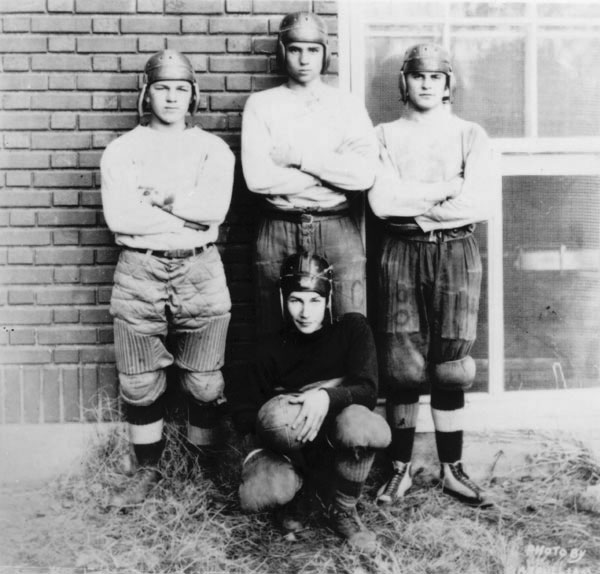
Am going to try this with my students. I think I'll start with these photos. The bottom one is from the Sedgwick County Historical Museum. The top one I've used for a year or so but don't know its story.


AJ Pullian (photographer), Hamilton Intermediate School, ca. 1925. Sedgwick County Historical Museum.

The afternoon and much of the time remaining at the Smithsonian was dedicated to working with technology. The interesting thing about the way they introduced it was that nothing we used was 'cutting edge'. The idea seemed to be to use current technology well. They introduced us to Audacity, Voicestream and Prezi. Audacity and Voicestream are audio capture programs and were used to record a podcast we'd been asked to create for out piece of art. Prezi is a presentation format. Think of PowerPoint except non-linear. The goal was to create a podcast and then a five minute presentation incorporating the technology and out pieces of art. I didn't see our podcast online but like this one so I'll show it as an example.


Saturday, August 6, 2011

"Reading Art"

Day Two of the Institute highlights...

Melanie Layne worked with us today on how to 'read art' and how to help students make sense of art when we use it in the classroom. Some of my notes:

Most art can be placed in a continuum from representational to non-representational.

Representational:


Non-Representational:

Abstract--abstract fits in between representational and non-representational on the continuum. Sometimes the 'representative' idea (in this Sheeler you can seen the buildings amid the geometry) can be easily seen but sometimes what looks non-representational has some sense of representation when you know more about the artist, the subject, the process.

Ms. Layne then walked us through a way of analyzing art with students. She broke the process down in seven steps and asked us to look at the art from level one; 'objects, lines and shapes' to level five 'location'. The first five are really identifying what you see--the decoding of the piece from general to more specific. The last two involve the interpreting of the art and then bringing all the separate levels into one cohesive connection.

Then we were taken into the gallery and asked to read 8 or 9 pieces in a 30 minute period. All of the pieces were from the 30s or related to the 30s. As a team, we tried the process. I wasn't shocked that it worked but how quickly we moved from art novices to eagle eyed interpreters of the peices. Once done, they asked us to reflect on the pieces and then write a six word story based on the collection. I'll give you a sample of one of the peices and my story. It will lose something in translation but ...

(BTW-the six word story is a cool tool to use with students. How do you get your point across in only six words? The most famous six word story is by Hemmingway: "For Sale. Babies Shoes. Never Worn.")

Diamonds are refined through intense pressures.

We then fused all of the six word stories into a poem or sorts. The cool thing about the process was that what I struggled to express in these images or missed completely, someone else got. It was powerful and I can see it translating back into my classroom.  I could also see this process working with historic documents as well. 


Monday, August 1, 2011

"What's going on in the picture?"

This afternoon we played with Visual Thinking Strategies (VTS). It is a series of three questions designed to help with observation and articulation of thoughts about a painting, sculture, document, ... VTS is designed to be a starting off point for discussin visual mediums. It is a great way to wrestle with primary sources so I was intrigued. It centers around three questions:
  1. What is going on in the picture?
  2. What do you see to say that?
  3. What more can we find?
Those are the only questions a facilitator may ask. They are encouraged to listen carefully in order to paraphrase each speaker's thought to make sure everyone is looking at the same in the part of the picture; remain neutral to any response and link comments which relate.We were then taken into the gallery and practiced the process on four different pieces. It is alot harder than it sounds. If it is an image you are really familiar with-you have to facilitate without giving away too much. If you aren't familiar with the piece-there is a whole different challenges. The goal is a directed dialogue focused on the piece of art. don't worry about who painted it, or when or even the title. Those aren't important - as a matter of fact, they may get in the way of the exploration.

Let's try it, okay? Look at the image belows and ask yourself the three questions. Remember, you have to prove your point with something specific to the image. Figure out why you have that gut feeling. Be specific. Think in terms of narrative and story? Think in terms of perceptions, prior knowledge even personal biases. Just be ready to name it a perception or bias.

Is there really no such thing as a bad question?

This is the 22 foot mural in its entirety.

Note: I wrote this on Monday but decided not to post it until today (Saturday). This conference was a challenge for me in that it travelled roads I don't know I've gone down as a teacher. I've spent the better part of the week processing what I've seen and how it can be translated into the classroom. Unlike the Presidential Academy, there was only a little prep for the Insitute. We selected a painting to research and did a short reading. It has been an intense week and I will do my best to highlight what we did. I'm still processing though so if my thought seem more incoherent thatn normal ...

Day one of the Smithosonian Institution's Clarice Smith National Teacher Institute. I have to admit, I was worried about burn out. The Presidential Academy was intense. So much preparation and a packed schedule. To sit for an hour and listen to art historian and tech people might be problematic. I shouldn't have worried. I walked out of the American Art Museum with more energy and excitment that I thought I had in reserve.

The big idea behind this conference is an exploration of how teachers can integrate art and technology in 'traditional' classroom. We were asked to select a piece to focus on and I chose a Thomas Hart Benton piece called Achelous and Hercules. Its the piece at the top of this entry.

The keynote today was by Ron Richhardt from Harvard University. His research looks at effective communication strategies in the classroom. His suggested that there were five types of questions in a class:
  • review: content, terminology, process...
  • procedural: classroom management; directing the work of the class; not content-based information 
  • generative: exploration of the topic or 'wondering out loud' questions;
  • constructive: questions which help build understanding and
  • facilitating: questions which promote the learner's own thinking and understanding.
One of the things his research documents is something that most teachers know but seems counterintuitive to many folks. There more you focus on review and procedure (think; teaching to the test) the lower the assessment scores are. When students are engaged through generative, constructive and facilitating questions, the higher the test scores. The more a student is challenged and encouraged to look past the 'quick and easy' answer to real understanding, the better they do on content-driven assessment.

Dr. Richhardt also outlined what he thought were four key qualities for classroom instruction:
  • Novel application-it has to be more than just 'practicing what they know'.
  • Meaningful inquiry-they need to wrestle with new understandings and insights
  • Effective communication-lock in  understanding by talking, sharing, debating, ...
  • Intrinsic value-a sense of accomplishment or appreciation
I'm still trying to wrap my brain around what these might mean for my classroom, but wanted to get them out there. One of the values of being on-site is that I have the luxury of time to think about what is the best way to teach my charges.  I miss my family like mad but I hope I'm using my time to wrestle with what I can do better as a teacher. My students deserve no less.

Nerding it up between conferences ...

The Presidential Academy ended on Thursday. That morning, I watched my collegues for the previous three weeks head back to Philly and I went to the hotel I would be staying at for the rest of my time in DC. Its weird, after 20 or so days of being on a strict schedule and seeing the same people day in and day out, freedom was kinda awkward. It took me at a day to shake it. In case I haven't said it, these women and men were phenomenal. I really admire them. Some of them work in amazingly challenging situations, whether it be inner city or at risk populations or with children of affluence and apathy, they inspired me. The perspective of teaching civil rights in the Deep South. The perpective of being the only person your race in a school of 2000. The perspective of surviving your first year teaching or your 35th. We got to be friends and I wish them all the best. Thanks for letting me tag along and listen in.

On Friday I earned my history nerd union card. I went to the Madison Library of  Building and got my Library of Congress 'reader card'. I am now authorized to research in the Library of Congress for the next two years. How cool is that! I went in twice, once to look for a novella by Ralph Ellison that Dr. Morel suggested and the other to look for information on James Madison's stepson, Payne Todd. Am going to try and get over there at least one more time this week.

The place you get the reader card is in the Madison Building. You didn't think I would get a picture of Jemmy in his LOC building?

Library of Congress Reader Card. Yes I know I'm not smiling. I was going for nonplussed but it went more toward mugshot.